1. What is the principle of LED, why is it energy-saving and long-lived?
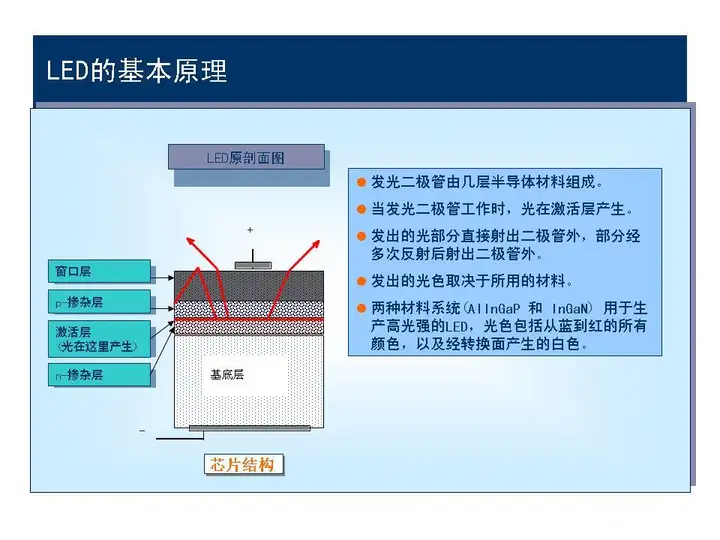
LED light-emitting diodes are mainly composed of PN junction chips, electrodes and optical systems. It utilizes a solid semiconductor chip as a luminescent material. The semiconductor chip is made up of two parts, one is a P-type semiconductor, in which holes dominate, and the other is an N-type semiconductor, which is mainly electrons. But time these two kinds of semiconductors couple together, between them, just form a "P-N junction". When a forward current is applied, electrons will be pushed to the P region, where the electrons and holes recombine, and then energy will be emitted in the form of photons, which is the principle of LED light emission.
The reason for energy saving is that most of the electrons directly transition into photons when they pass through the PN junction; the ratio of conversion into heat energy is much smaller than that of traditional light sources, so energy saving~
The reason for the long life is that LED is a solid-state light source. Once the standard product is produced, the structure is relatively stable and simple. It is more durable than traditional filament, low-pressure gas, and high-pressure gas light sources.
Come to a simple section to show
2. Is the manufacturing process environmentally friendly?
In fact, from the current existing technology, heavy metals such as lead and chromium are used in the manufacturing process~
And if the light color that meets our needs is produced, phosphor powder is indispensable. Both the phosphor powder itself and the manufacturing process are highly toxic.
At present, it is inevitable to use unenvironmentally-friendly raw materials and processes in the production process of the electronics industry, but the most important thing is how to ensure that the emissions of products and factories are environmentally friendly. As for the manufacturing process, let the relevant workers improve it!
3. What materials are used?
This is more, as I said just now, the simplest LED particles contain a lot of original components.
Take the PN junction chip that everyone is generally concerned about as an example. Many manufacturers have different processes and raw materials. But basically it belongs to the material category of chip manufacturing. Such as: sapphire substrate, silicon carbide, silicon dioxide, gold wire, etc...
If you are interested, you can discuss it further, so I won’t be long-winded here.
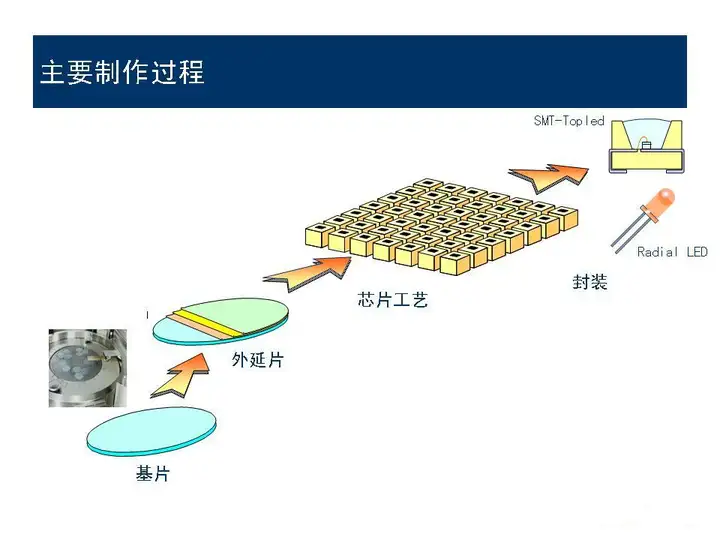
Finally, share a simple flow chart of the LED manufacturing process~